Like many I've been waiting patiently for new material by Seattle's Samothrace. 2008's Life's Trade is a phenomenal record - perhaps one of the best records of all time in the greater doom genre. Needless to say, expectations are quite high for Reverence To Stone.
My vinyl copy came in from 20 Buck Spin yesterday and I am delighted. All of the trademark elements of Samothrace's sound are still present five (perhaps slightly turbulent) years later. Furthermore there seems to be a deliberate and purposeful refinement in their songwriting. The two pieces that comprise the album bare an exquisite preciseness; I have no doubt that the band took their time to make sure these songs matched exactly their creative vision, and it is clearly audible.
The greatness of Samothrace is in the passage of riff to riff, motif to motif...each lavishly explored, beginning with a sense of self-manifestation and ending like a phoenix combusting into its next form - a drawn but beautiful series of auricular movements. Though these tracks clock in at roughly 15 and 20 minutes, they don't feel anywhere near that long. Completely capturing the undivided attention of the listener, they surround as they pass and effortlessly carry you along throughout their full run. Riffs twist and turn up steep slopes, gaining speed as they approach a mountainous peak in a heaven of dense misty clouds and refracting sunlight setting against a broad colorful horizon...and then they dissolve into the dark and brooding depths of cold, damp caverns harmonically rich with feedback and noise, guttural wailing, and sparse reverberating percussion. Reverence To Stone ascends and then descends, saturated in a profoundly awakened heaviness and affection for cathartic melancholic beauty - it is an intense experience, and highly recommended.
You can listen to the album online thanks to Pitchfork. I've embedded their uploaded tracks here for your convenience...enjoy!
I have not really explored electronic music for quite some time, so admittedly I am far out of the loop. That said, it did not take me long to turn up the latest release from Silent Land Time Machine, and it's blowing my mind. I am no longer alone with myself and can only artificially recall the scary and beautiful feeling of solitude is, as a title as well as a record, a tremblingly lustrous piece of poetry. Each track steeps within the senses, working into the fascia of the physical and ethereal bodies where it saturates into the solidarity of our experience. As the record comes to a close, it carries a weight...you know that feeling when you've just finished reading an incredible book - one that spoke so deeply to your heart that you truly felt understood - one that left you with heightened energy and the sense of perfect aliveness? You assimilate the reading of that literature into the fabric of your being; from there on out that book is intertwined with who you are and can no longer be considered merely a physical object on a shelf. Try this on for a while and see how it fits...
Whilst Record Store Day last month may not have been everything that I wanted it to be, the day was later ameliorated with the arrival of a very limited edition pressing of Alcest's Les Voyages de l'Âme. I had been patiently awaiting this vinyl's presence in my collection and had been tying myself over by streaming the record on Spotify pretty regularly since its initial release. This special edition is on 180g gold-colored vinyl and unlike the first pressing dons the original gorgeous album artwork:
Les Voyages de l'Âme is overflowing with beauty to the extent that is just not possible to describe with words; I've honestly been putting off this post because I'm rendered speechless every time I sit down to listen to it. Les Voyages... is an observation and artistic representation of the eternal part of what it means to be human - our legacy of touching the earth - the immortality of continuous generational knowledge and growth. This is not just a record, but an affirmation of humanity on a personal, intimate level. Further, it's a journey that can only be taken after a fall to a low, dark place. Some form of clarity arrives and the ascent begins...the bittersweet rise from the ashes of the phoenix. Some part of yourself is gone - left behind and not to be felt ever again, but with this transformation comes rebirth and the immense energy of an empty canvas.
I can feel my heart break but also open continuously...it could be a very confusing state for attempting to discern its reason or validity. Alcest's sound is the expression of this transfiguration of emotion from anguish and immense sadness to pure love and resolve to light; it's the wavering motion of emotional intensity and the understanding thereof with a clarity of heart. Through most of the record vocals are sung cleanly and comprised of delicate and graceful melodies set atop a strong foundation of varied guitar work and chord progressions. Occasionally brutal howls underly the deliciously lush vocal phrases and drawn melancholic instrumental motifs. Some passages border on shoegaze, others on blackened doom metal...and incredibly there really does seem to be nearly everything else in between at one point or another. Everything fits and flows like a natural and rocky stream - the whole record is delivered smoothly and with an organic confidence. It is also clear that Les Voyages... was meant to be taken as a whole, telling a sort of musical spiritual fairytale - chalk full of the mystery and majesty of life. It's a lonesome and well-needed wander through the wood: a meditation of the heart's song.
Speaking of walks in nature, Alcest has just recently released this lovely promo video for the title track...
The second side of the record opens with angelic choral vocals, immersing the listener in a dream state until blast-style percussion and driving guitars spill into the mix for one of the record's most powerful moments. When I hear this, I can only listen and not help but be swept away...
Les Voyages de l'Âme is easily one of my top picks for 2012; I have fallen in love with it. All sung in French it is quite the sensuous treat - a sumptuous feast. If you have not explored this masterpiece of an album yet, you are truly missing out on something quite special.
I was introduced to San Francisco's Sleepy Sun a couple of weeks ago and cannot stop listening...nor could I resist the sweetness of their sound on vinyl. Both Embrace and Fever, their first two albums, arrived by post this weekend. Their third, Spine Hits, will be released April 10th and supported by a lengthy tour. I've preordered my copy at The End Records' webstore for a mere $12.99. Rumor has it that we came very close to getting a tour date right here in Peterborough, NH that fell through...quite disappointing.
I love high grade vinyl...too much, perhaps. Both these discs are top notch pressings and filled with classic rock haze. Like when the sun is muted behind a veil of passing clouds that eventually break and give passage to the intensity of light, energy, and warmth - Sleepy Sun oscillate beautifully between the shimmer of mellow psychedelic hippy jams and an electric cascade of stoner fuzz rock-and-roll. The softest moments are stripped down to acoustic folk ditties, while the heaviest are rich with warm distortion and falling-tree riffs. It's quite possible that Sleepy Sun are equally as influenced by Simon and Garfunkel as they are early Black Sabbath. Vocals throughout are smooth and robust, featuring male and female voice in duet and lush harmony. The integration of all these elements couldn't be more fluid and natural; Sleepy Sun make lovely, lovely work.
Wild Machines (Fever)
Golden Artifact Official Video (Embrace)
I highly recommend checking them out, with Fever as a starting point.
Liturgy have received much flack from the metal world - most specifically from black metal elitists. From a flat, surface-level perspective Liturgy are a disgrace to black metal; they don't adhere to the 25+ year old genre's sound or intent. Or do they...
Things change. Black metal set out to be the antithesis of religion, culture, art, and what people considered good music. It was a rebellion that peaked in some very intense moments. These types of movements are generally short-lived; they either fade out of the picture or are so successful in their method of defiance that they become part of the accepted greater picture of valid artistic expression. A parallel can be seen with the early punk scene, which today has a similar fan-base divide as black metal. Many look at punk as having become a mockery of itself: a mainstream, mass-culture genre that is exactly what it originally set out to defy. Black metal is the extreme and grim younger brother of punk. Black metal was a very powerful movement in music that has become a common-day commodity. It has become an accepted genre of music which pretty much negates its original point. Though some will claim it died, black metal is still around - but it doesn't mean the same thing. It had risen from the ashes of burnt churches and bloody murders to find its home as the dark heart of the music world across the globe. Its raw, harsh, and abrasive sound has turned into label-name, big budget, professionally produced legitimacy.
Liturgy embrace this truth, making black metal as spiritual art - defying the genre with which they are associated in a way that transcends many of its fundamental ideologies, yet embraces its rebellious nature. They're creating their own new wave of black metal; their sound is coarse, unconventional, and unforgiving...even and especially to the ears of the black metal elitist. In this sense they have revived the aspects of black metal that had fallen to time and success, but also have let go of its preconceptions and paradigmatic negative close-mindedness. Liturgy have transcended its hatred and grim nature by affirmation.
The Thrill Jockey double-sleeved, double clear vinyl pressing.
Hunter Hunt-Hendrix's demos laid a foundation that Renihilation then built upon and refined. 2011's Aesthethica sees Liturgy approaching a mastery of their sound, writing and performing as a single breathing entity. Amidst the scraping trem-picked high-register minor and major chord structures - a swirling flurry of remorseless guitar power - thunders a rolling "burst beat" rhythm section. Utilizing Deutsch-like auditory illusions, Shepard Scale effect, and shifting polyrhythms that circle back onto themselves, Aesthethica is progressive and also psychedelic. The patterns and rhythms elevate you; ever-augmenting droning phrases cycle and climb - eliciting a growing tension of energy until they break, pouring out in a tidal wave of majestic riffing played with sacred intent. It's intense...and when the intensity of a song subsides there is an enriching silence - a stillness of being.
The screechy, animal screams are a perfect match for the music Liturgy creates. These are not guttural death vocals - they are shrill and unsettling. They are not supposed to sound good...this is black metal...black metal in 2011 at that. It ought sound grating even to fans of extreme music. Potentially as bothersome to metal fans are the various moments of Aesthethica when meditative and repetitive layered chanting enter the mix- a fitting contrast to the power and vehemence of Hunt-Hendrix's wails.
What makes Liturgy black metal is not something as simple as image, production quality, or musical key. They defy all of these things by remaining in alignment with their art and still, even more rightly so, deserve their self-devised genre of Transcendental Black Metal. Liturgy revive many of the original elements of black metal, but in a new fresh breath. They have brought black metal full circle, now not only defying the original movement and current interpretation, but also those who refuse to move forward...and in an accidental way. They aren't concerned with being "tr00" or "kvlt" - they are expressing a very unique vision with their music. Liturgy have spirit and are uncompromisingly defiant by being so dedicated to serving their creation.
Aesthethica is a profound record and I hope you will check them out if you have not already; it's one of the best metal records of 2011.
Lost In The Glare is Barn Owl's latest release and their most cohesive record to date. Engaging the listener even more so than previous offerings, it narrates a story from beginning to end in which our subconscious is free to assign the setting and symbols. This will of course differ from person to person, but so too will it differ on each spin for the same listener, never quite setting you down where you would expect based on previous listens. Each observation of the album is unique in some way - the mark of a truly great record.
Your particular journey may start in the sands of a sun-drenched desert gazing into a blue sky...or perhaps you find yourself waking in the forest as the first rays of morning sun cast through the spaces between bark, limb, and leaf. It may take you to the top of a dune, gazing into the chill starry night, or down a wooded dirt path you've never traversed to a lost meadow, illuminated by moonlight. Regardless, the celestial - sun, sky, stars, or moon - and terrestrial -sand, dirt, rock, or brush - are key. Lost In the Glare provides an experience comprised of this duality of energy and its embodiment as our conscious physical form.
This album transcends the mysterious familiarity of its predecessor and provides its own paradox. Lost In The Glare is more earthly and human than the ethereal, spacey, and mystic Shadowland - its closer to our natural experience. As it spins it waivers back and forth between two worlds: the physical empirical micro world, and the metaphysical cosmic macro world. Age old is the contemplation of the spirit, mind, or consciousness and just how it is connected to our corporeal flesh, blood, and bones: the Mind-body Dichotomy. We can deliberately deny one or the other, but it never quite works...we feel that we denounce a part of ourselves or our experience.
We can assume a strictly physical world of cause and effect, actions and reactions...but what and when was the initial motion? How did it happen? What existed before it? What is our consciousness? Physics and science is our ever-changing theory to make sense of what we observe. Very often a scientific breakthrough changes how we think of the world, leaving us in doubt of the "laws" we typically assume and take for granted.
We can also assume a strictly non-physical reality where everything we perceive is a creation of our mind alone...but then why do we experience life the way we do? Why do all of our sensations and day-to-day passages of time feel so convincing and believable as an external physical world? Are the other people we encounter in our lives real or just part of our mind's dream as well? Why would our mind create a world in which we experience pain, disappointment, and so many unknowns? If this experience originates in our mind why are we unaware that is case?
Lost In The Glare is a sonic expression that, perhaps subconsciously, reflects the human spiritual condition and the problematic duality of the very nature of our existence. Its pieces wander between the warming, white energy of the celestial sky and the heavy, buzzing energy of the Earth. The former enters through the scalp and crown, and runs down into the lungs, and pulls up to the heavens - a perfect love and presence represented by the synths, feedback, and airy electric guitars. The latter vibrates and shimmies its way up through the feet and into the belly, and pulls down to the Earth's center - a massive hearth of rock bisecting two intense magnetic poles represented by the strummed and plucked acoustic strings, rhythmic percussion, and gritty electric tones. We find ourselves in the middle - sometimes spiritual beings in a spiritual world, and other times physical beings in a physical world. We try to understand our condition as a bridge connecting our two conceptual worlds, but cannot quite see how it all fits.
Without the personal spiritual revelation that reveals the oneness of these seemingly two different worlds we will forever search. The problem really isn't a problem, but rather an illusion born of our perception of a duality...the problem is the very duality we think we are experiencing. We are of the earth and of the cosmos - we are of substance and of space - we are of the same infinite fabric of all that is. With this realization is also one of the holiness of flesh and the sacred observation of time. Barn Owl's record reaches far and is an absolutely profound expression, and an astonishing work of art. It's a set of signposts that point to this singularity, and even momentarily touch upon it by use of the gong and a very fuzzed-drenched guitar. These two provide timbres that resonate with both earth and celestial energies thusly bringing our two worlds together...but it's just a glimpse. Indeed, we may find ourselves at the end of our story searching in meditation while the answer lay without - lost in the glare.
The Darkest Night Since 1683 - The earth is lit only by the energy of stars. A dark night is one in which the sun's light
nearly does not reflect at all from the surface of the Earth's moon, nor the light of other stars reach Earth through a thick veil
of atmosphere, and perhaps some far off interference in space. Sometimes we forget the grand scale of conditions that
provide the means for our life and ability to sense the world.
Boston's Junius have released a new record, to which I am listening at this very moment thanks to my friend Justin Hull who introduced the band to me a couple of years ago. Reports From The Threshold Of Death is just lovely work: thoughtful and heartfelt, poppy yet heavy, abrasive yet smooth, and most predominantly - full.
The album maintains a wonderful motif of fullness, lightness, and understanding. Even the heavy parts are somehow ethereal and soothing in a way that I find unique to this record. Full spectrum sound sweeps through your speakers as a singularity - one comprised from a swirling chorus of voice, airy synth pads, distorted guitar grit, and tidy well-placed percussion. At times it feels like the epic soundtrack to a surreal and fantastical film, full of astounding otherworldly images. Vocals are simple and straightforward - void of the gimmicks and trends that seem to infect today's rock genres like plagues. There is certainly both confidence and maturity at work here; nowhere is there overcompensation or even a single note or beat that does not fit. Junius are doing what they do, not answering to any particular expectation.
Reports From The Threshold Of Death rejuvenates the listener with a calm clarity. The deafening silence met at the end of the album is a testament to the richness of its sound...it leaves the listener in content reflection. There is no urge to respin this record after a complete observation...not because it isn't a great record, but because it is a different kind of great record: one that is whole and complete just as it is - not in need and not in surplus...and that is quite special.
The vinyl pressing is excellent. I opted for the band's website-only edition which is an exquisitely gorgeous piece of vinyl, which you can see below - a very nice complement to the album's artwork.
Junius have clearly reached new ground, and their footing is sure and solid. Where their next climb will take them should be very interesting indeed.
September 16th, 2011. Through the September night chill my good friend Cassandra and I walked a handful of city blocks from where we parked to the micro venue that is O'Brien's Pub in Allston, MA. In a space maybe a tad larger than twice the size of my living room was contained a bar, corner stage, and makeshift merch table. The four acts to perform that evening could be found mingling with members of the audience, who were few and fortunate. O'Brien's was buzzing with a mellow warmth - an anticipating, welcoming, and thankful energy.
Stillborn, the first opener, served us a twitchy electronic onslaught chalk full of amazing transitions - abrupt yet strangely smooth at the same time. Imagine a time signature, tempo, and key change somehow occurring naturally over the course of a measure or two; it'd be enough to slap you in the face but Stillborn makes it easy...leaving you wondering just how the hell he did it. Next was Lussuria's dark, ambient, and swelling synthezised soundscapes. Containing some industrial nods the undertone was cold and grim, but, as two strangers can bond through grief, also presented a gesture of universal connection. The third opener, High Aura'd, was slightly more organic - one man looping several layers of effects-drenched guitar, hum, and feedback. An immense repetitious drone stuck to the air in the club as he worked through his set, successfully and gracefully closing the loop from the first two openers to the main performance of the evening.
Barn Owl's Jon Porras and Evan Caminiti finally took the stage and what followed left me in awe. The sounds found on their records were here impeccably reproduced in raw live spirit. Layered waves of a weaving sonic tapestry pushed out the walls as we settled in to a growing space. The fact that this full sound - swirling, shimmering, soaring, and shaking - was being produced by just two men on stage was truly astonishing. Most impressive was their unbeleivable mastery of feedback. Barn Owl uncannily induce precise tones, timbre, and squeal as elements of their compositions.
They moved beautifully through their set without speaking nor recieving applause, which was held until the end. Their eyes closed in focus, bodies swaying and swinging naturally through meditative musical practice, Barn Owl's live experience - much like their recordings - can be both cathartic and transcendentally affirming. It was evident that Porras and Caminiti were incredibly tuned in to each other during their performance; it was as though they were one creative entity, existing only and continuously as the moment in which their sound became music. Absolutely astounding.
From the opening percussion and hand-clapping of Split The Lark to the heavy powertrip and stuttering finale of Width Of The Tunnel, Brainstorm's Battling Giants more than pleases the ear with interesting musical antics and fun ideas...all executed in such a way that appeals equally to the inner child, musician, and poet. This is some seriously creative indie rock from Portland, OR.
Photo From Brainstorm Facebook page.
The sometimes overlapping and/or harmonized vocals ebb and flow, usually crescendoing just in time for squiggly, trilling guitars to writhe in distortion or fuzz, scampering around their favorite scale and crashing into walls of power chord waves. Rattlesnaking, jangling, and thumping percussion manages to ride along and keep things as "structured" as they'll get. Brass makes its way into the mix rather randomly at points in the record, teaming up with some synth goodness for the poppy title track. The anthemic We Are Free resurrects a spirit from the 1960's, while Bottom Of The Sea adds some southern fried, foot-stomping folk-and-roll. Uh Oh Black Hole! is something like They Might Be Giants performing a traditional Russian dance for the first surfing astronaut brigade. Impressively, Brainstorm know just when and where to take their songs...nothing here is forced or feels contrived - it's zany not by design, but by nature...and it all works brilliantly. It's hard to believe this is just two guys (with occasional guest female vocals).
Catchy, inventive, and full of energy, Brainstorm are an exploratory playground of awesomeness...like a rock-and-roll ice cream truck operated by a poetry professor - and it's just as beautiful as it is unusual. You have to hear it for yourself...
The entire album is available on their bandcamp page here. It is highly recommended. 5/5
September 19th, 2011. Opeth's 10th record in not a metal record. No death vocals. No detuned, wildly overdriven guitars. Mikael Akerfeldt has moved on and has been quite frank about it in recent interviews. Still, there were many disappointed fans at Monday night's show which kicked off the world tour for Heritage. I was not one of them.
Opeth's change of pace comes at a great time in my life, so perhaps I am just more open to it at this particular juncture. The Heritage album speaks on its own - its blend of 1970's prog, hard rock, and fusion elements combined with Akerfeldt's caliber of songwriting is a welcome addition to my collection any day. This turn in Opeth's sound also allowed them to rethink their live performance - they opted to fill the set with oddball songs and "obscure" b-sides, which never had their place when Opeth had to fill our ears with metal and could only select maybe 10 or so songs due to song duration and set time.
Predictable opener The Devil's Orchard was followed by its successor on the record, I Feel The Dark, and then by the classic Face Of Melinda. But that's where predictability ended, and because of what came afterward I felt very lucky to be seeing the first show of the tour. From Watershed came Porcelain Heart, which even though was a single has never before been played live. They followed this with another new track, Nepenthe, before derailing us on an acoustic foray. "This is going to get strange...", Mikael warned as he tuned up his acoustic. What came next was a fantastic first live performance of Throat Of Winter (originally recorded for the God Of War 2 soundtrack and recently released on 7" vinyl), followed by a tripped-out rendition of Credence which featured light synthesizer accompaniment, and another first-time performance of a formerly rare Patterns In The Ivy II. The acoustics were taken offstage and the crowd responded in anticipation and need for a few heavy cuts; "Deliverance" was repeatedly screamed from somewhere far off behind me...boy was that guy disappointed when the next song was introduced as a Rainbow ripoff and tribute to Ronnie James Dio - Slither, a new shorter song certainly stepped up the energy a notch, but just wasn't enough to satisfy the crowd's craving for progressive death metal. The set was rounded off with an extra lengthy version of A Fair Judgment with an ultra slow doom-laden ending, and Hex Omega.
The set choices really reflect a deliberate shift, and opened up the possibilities for Opeth to play some really interesting songs that never found their way into live performances on past tours. Further, all of the set's tracks really fit together and create a sense of cohesion between their new sound found on Heritage and their previous work. Really breaking tradition was the new song Folklore as an encore in place of the tried-and-true Demon Of The Fall. Maybe I'm the only one, but I had become bored of always hearing Demon as the standard Opeth encore time and time again. While many others walked way grumbling and moaning, I found myself filled with a refreshing energy and happily soaking in the sounds of new Opeth. Like the new record, the live performance contained not a single death growl...indeed we're at a crossroad and to make room for the new, some older things, though missed, must be discarded.
Listen to the entirety of Heritage on NPR Music here.
Opeth @ The Palladium Sept 19, 2011 (Photos by Dan Wyatt)
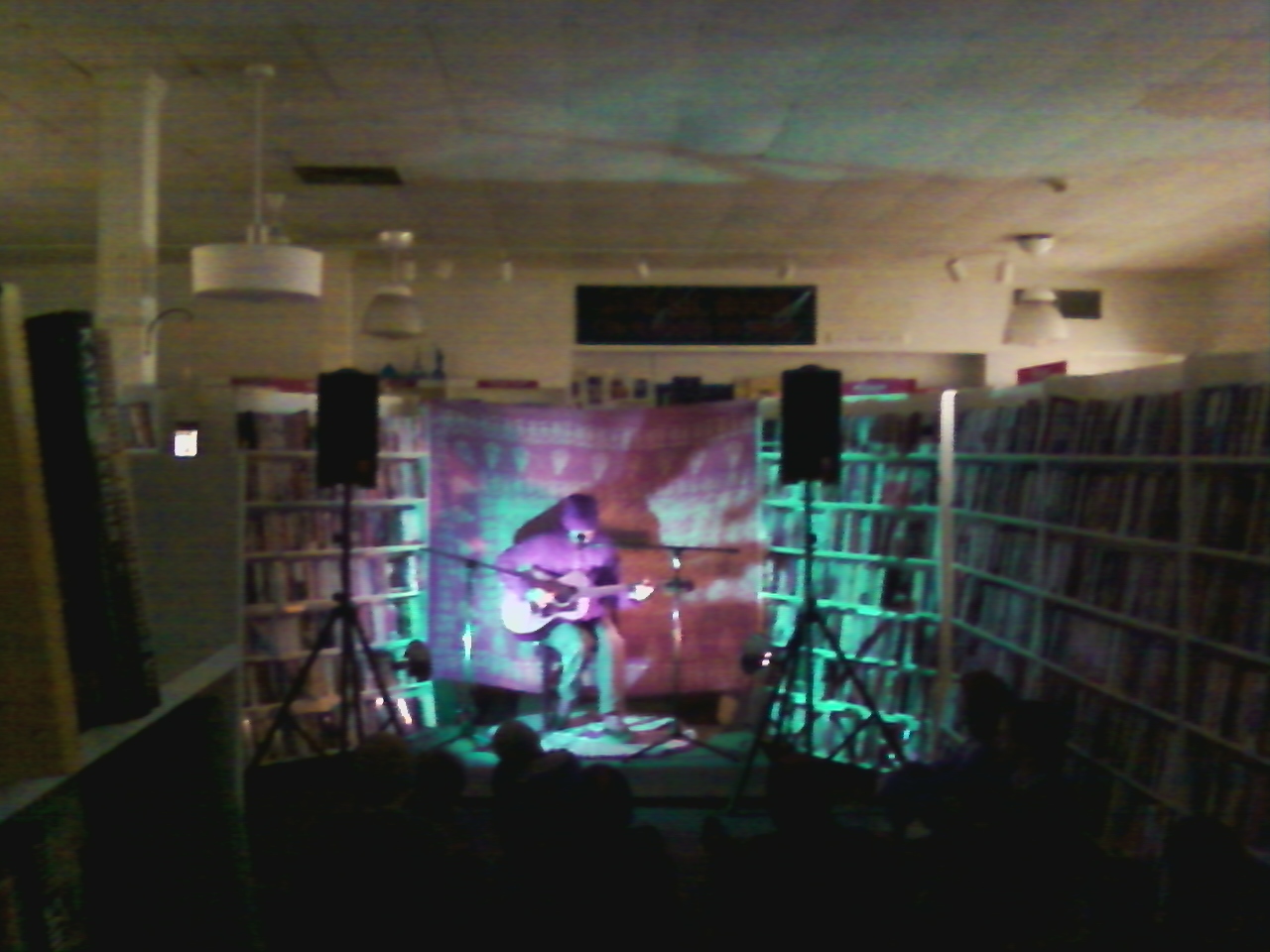
January 15th, 2011. Three artists. Three twelve-string acoustic guitars. One small makeshift stage. A handful of locals gathered after hours on the floor amidst the bookshelves of The Toadstool Bookshop in Peterborough (NH - USA). The vibe and volume of these shows has changed a bit since moving into the bookshop from the previously vacant space next door, but they are still intimate and warm.
Opener Timothy Horgan of Keene, NH sat awkwardly on the wooden chair as he performed his beautiful finger-picked instrumentals. The small crowd breathed his music in silence as he set the mood for the remainder of the evening. I found his pieces refreshing and energizing; an honest and straight-forward expression without need for lyrics. A great example would be Speed And Comfort, which you can hear on Tim's myspace page.
Tongue Oven, out of Pioneer Valley, followed suit – a single man playing mostly instrumentals on twelve-string acoustic, though normally seen as a banjo/guitar, violin, cello three-piece. Tonight Mr. Oven, lacking his more sophisticated fretless stringed partners, played many pieces featuring slide guitar and harmonica. His well received set built on the energy of Mr. Horgan's but added a few shots of bluegrass sass. He wrapped things up with an interesting and purposefully out-of-tune ditty, which he also sang.
Micah Blue Smaldone came down from Portland, ME and took the stage last with his trusty and worn twelve-string Guild. Continuing the impromptu theme of the evening he opened with a short instrumental. He then proceeded into a nearly non-stop recital of several songs from The Red River, beginning with Pale Light. Between songs Micah filled what would have been praise and applause with strumming and finger-picking, leaving the audience zero time to send him the thanks they wanted. Finally taking a breather, Micah received his much deserved applause, after which he played a few more songs. Besides the aforementioned Pale Light, in the barrage where A Derelict, Bastard Of Time, The Clearing, and A Drink. I failed to recognize a couple of songs, either covers or tunes from Some Sweet Day or Hither & Thither, his previous records which I have not had the pleasure of attaining. He ended his set with a fantastic cover of The Congos' Fisherman, which he seems to often incorporate into his performances.
The Red River
I first heard Micah during last year's The Thing In The Spring festival, and instantly fell in love with his songs. His latest offering, The Red River is a truly magnificent record; full of feeling and a haunting vibe, it leaves you craving more after its only seven songs have permeated your speakers. Don't get me wrong, though short the album isn't lacking one bit. In fact it leaves me in a mood where no other record seems fit to follow and I often end up just playing it again. Micah's shows usually include just his voice, a twelve-string Guild which he finger picks, and a couple of microphones, but The Red River features an array of guests including cello, bass, electric guitar, horns, percussion, and additional voice. It may seem over the top for such a stripped-down style, but the additional instrumentation is light and focused on augmenting his original songs. It just works, and works beautifully; fans of the record may not even notice the lack of accompaniment during his live performances. Tonight I was able to pester Micah a bit after the show to inquire about any forthcoming recordings and I am happy to report we should see a split 7” with Big Blood sometime this spring...just in time for Peterborough's annual music festival; hopefully we'll see him again in 2011.
I feel like I've been missing out. I only just recently picked up the latest from Intronaut, so this commentary is not really news to most fans of the band. I've been a huge fan of Intronaut since the release of Void, when I first heard them. With each new release my thirst for more of their unique style is quenched just enough to leave me satisfied but also entice me to crave more. Intronaut have a great way of challenging their listeners to want to hear every single nuance and cadence. I couldn't be more impressed.
The first thing that grabbed me about Valley Of Smoke was the vocals; not only are they much more refined and diverse than in previous Intronaut releases, they now come to the forefront and are perhaps the most pronounced aspect of Valley Of Smoke - a significant change for the band and their songwriting. Vocals range from gruff growls to clean and soaring multi-part harmonies...and in some instances layers of the two extremes and/or various interpolations. These songs are more built around the words and the message, rather than the lush and weighted sonic landscape for which Intronaut is known, and which mostly remains in tact. The difference really is that each song has more definition in and of itself. Previously, Intronaut records were built on evolving layers of texture and sound, creating space or ambiance...a flowing stream of progressive post-metal that defined an album as a whole, each piece being a constituent but necessary irreplaceable part. Valley Of smoke manages to retain this airiness and ambiance, and strength as a whole, but also more deliberately and purposefully shapes each song into its own complete point of focus. The space has been filled with intention and clarity. In riffs there is more of the same; they are more focused and rely less on dissonance than in the past. The production of the record also echos this general theme: the stereo image is a bit narrower than Void and Prehistoricisms, and the positional placement tighter.
Intronaut have continued to churn out extremely high-quality releases since their inception, and Valley Of Smoke is no exception. They have reached a new and different stride with Valley Of Smoke. Some hardcore metal elitists may be quick to find fault with some of the changes, chalking them up to the influence of more commercially popular bands (Mastodon comes to mind)...but they'll be missing out. While Void remains the most brutal of Intronaut's offerings, Valley Of Smoke signals the band reaching a point of maturity. As a fine wine improves with age, Intronaut are indeed more flavorful, robust, and sophisticated.